The Asymmetry of Growth: Why India’s Economic Model Demands Structural Reform
The Asymmetry of Growth: Why India’s Economic Model Demands Structural Reform
By Bharat Asudani
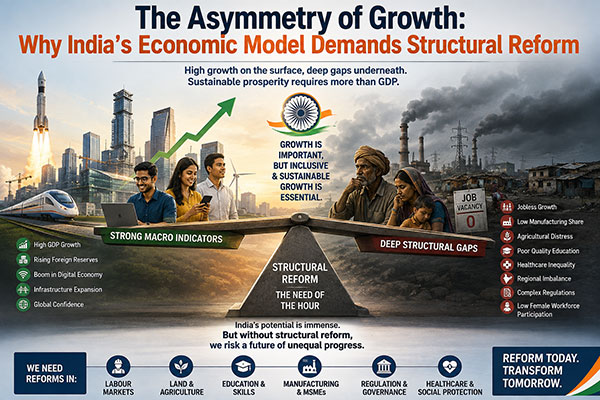
In modern economic discourse, national success is frequently equated with the expansion of high-margin service enclaves and rising Gross Domestic Product (GDP) figures. Yet, beneath the surface of this financial growth lies a profound structural disconnect. An economy that allocates its most valuable resources to high-margin digital enclaves while underfunding the foundational sectors of human survival creates a deeply fragile society. Rebalancing this system requires moving away from unplanned industrialization and returning to planned production for fundamental human needs.
1.The Subsidized Enclave Economy
The rapid expansion of the Information Technology (IT) and digital service sectors in India—which directly employ roughly two percent of the working population—has not occurred in a vacuum. It has been actively underwritten by state support:
* Tax-Free Status: Special Economic Zones (SEZs) provide extensive relief from direct corporate taxes, sales taxes, excise, and import/export duties.
* Resource Reallocation: Vast tracts of public and agricultural land are routinely diverted for technology parks at nominal rates, alongside subsidized utilities and state-backed financing.
While originally intended to jumpstart foreign currency inflows, this model effectively uses public wealth to build private, high-margin infrastructure. The wealth generated within these enclaves remains highly concentrated, yielding minimal direct reinvestment into physical manufacturing, agricultural security, or basic civic infrastructure.
2.Market Distortion and Local Inflation
Because the financial gains of this sector are concentrated within a narrow demographic, the resulting purchasing power creates severe inflationary pressures in primary urban centers:
* Direct Capital Concentration: High-margin enclaves generate concentrated purchasing power among a small slice of the workforce.
* Cost-of-Living Escalation: Real estate prices, private school fees, and healthcare costs rise rapidly in surrounding urban hubs.
* Real-Wage Erosion: The remaining 98 percent of the population—including farmers, laborers, teachers, and municipal workers—face hyper-inflated living costs without matching income growth.
Furthermore, surplus capital from these high-margin enclaves frequently spills over into secondary investments. Through informal partnerships and private acquisitions, capital buys into local supply chains—commercial real estate, private education networks, and captive vendor services—effectively transforming basic human necessities into high-yield, speculative assets.
3.The GDP Fallacy: Growth vs. Living Standards
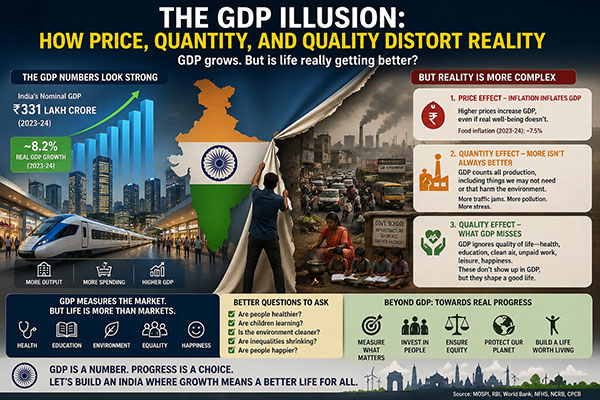
National accounting frameworks routinely celebrate this transaction velocity through GDP growth. However, GDP measures the financial value of transactions, not their quality or social utility. This creates three major distortions:
National accounting frameworks routinely celebrate this transaction velocity through GDP growth. However, GDP measures the financial value of transactions, not their quality or social utility. This creates three major distortions:
- Price Inflation Distortion: Rising prices for fixed or declining quantities are logged as a net increase in market value. Higher baseline spending is misconstrued as genuine economic progress.
- Shrinkflation Trap: Reductions in product volume at stable prices maintain sector revenue figures on paper, even as consumer purchasing power declines in reality.
- Quality Degradation Paradox: Lower-quality goods or environmental hazards generate secondary spending, such as rising medical bills. Spending required to correct systemic failures is perversely counted as positive GDP growth.
Under this framework, an inflated rent payment or a hospital bill adds to national growth figures, even as it erodes the actual living standard of the average household.
4.Reclaiming Planned Production for Essential Needs
A resilient economy cannot depend solely on the speed of digital transactions. A stable society must be anchored in the planned cultivation of its Five Essential Pillars:
1. Food (Agricultural stability and supply chain security)
2. Shelter (Affordable housing and civil infrastructure)
3. Clothing (Domestic manufacturing and textiles)
4. Health (Accessible, high-quality public healthcare)
5. Education (Foundational literacy and skill development)
To correct the current structural imbalance, policy priorities must shift. Public credit, land allocation, and tax incentives must be redirected toward the primary industries that directly sustain human life. By prioritizing planned production over speculative extraction, national development can ensure that economic gains translate into genuine, long-term stability for the entire population.
Explore more opinions, analysis, and insights by Sujit Chatterjee .