The GDP Illusion: How Price, Quantity, and Quality Distort Reality
By Bharat Asudani
In the modern economic landscape, we are taught to worship a single number: Gross Domestic Product (GDP). It is presented as the ultimate barometer of a nation’s health. However, if we peel back the layers of this capitalist metric, we find a sophisticated manipulation game where the figures rise even as the quality of life for the average citizen declines.
Using the simple example of a liter of milk, we can decode how "growth" is often a manufactured reality.
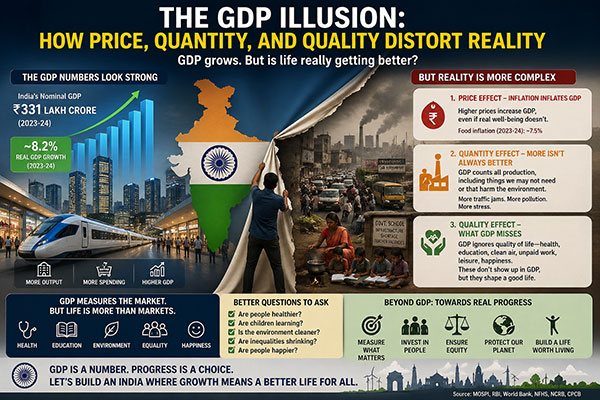
1. The Price Game: Inflation as "Progress"
In a healthy economy, growth should mean we are producing more or serving better. But GDP is calculated based on market value.
- The Scenario: If a liter of milk costs ₹60 today and ₹80 tomorrow, GDP reflects a massive spike in growth.
- The Reality: No extra milk was produced. No child received more nutrition. The "growth" is merely a reflection of a higher cost of living. We aren't getting richer; the numbers are just getting bigger.
2.The Quantity Game: The "Shrinkflation" Trap
Capitalism rewards the ability to extract more money for less substance. This is often achieved through the manipulation of quantity.
- The Scenario: A company reduces a milk carton from 1 liter to 900ml but maintains the price—or raises it slightly.
- The Reality: On paper, the sector’s "value" remains stable or grows. In your refrigerator, however, there is less food. This reduction in quantity is a hidden tax on the consumer that perversely fuels the GDP engine.
3.The Quality Game: The Purity Paradox
Perhaps the most cynical manipulation is the sacrifice of quality for the sake of volume.
- The Scenario: To maximize profit, a producer adds water to the milk, reducing its purity but increasing the total number of liters available for sale.
- The Reality: GDP increases because more "units" are sold. The system counts the 120 liters of diluted milk as a greater economic success than 100 liters of pure milk. The loss of nutritional value is never subtracted from the national balance sheet.
Unplanned Industrialization and Artificial Growth
This "milk logic" applies to our entire industrial complex, including the service and tech sectors. We see unplanned industrialization where the focus is not on social utility, but on the velocity of transactions.
- Planned Obsolescence: Products are designed to break, forcing a new purchase (GDP growth).
- Negative Externalities: When low-quality production leads to health issues or environmental decay, the money spent on doctors and cleanup efforts is added to the GDP.
The Paradox: In our current system, a car accident, a diluted product, and a rising hospital bill are all "good" for the economy because they represent money changing hands.
Conclusion: Measuring What Matters
GDP measures the speed of the machine, not the direction in which it is traveling. It celebrates the manipulation of price, the reduction of quantity, and the dilution of quality because it lacks a moral compass.
As we move toward a future of increasingly artificial industrialization, we must ask: Are we actually growing, or are we just paying more for a "watered-down" version of life? It is time to look past the figures and demand a system that prioritizes planned production for human need over the mechanical manipulation of market value.
By Bharat Asudani