TOURISM MARKETING
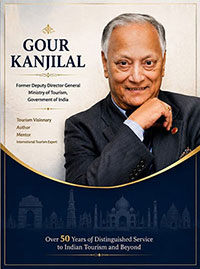
Dr. Gour Kanjilal
[ Author And Tourism Representative Govt Of India ]
Marketing is an important management function of the Ministry of Tourism. Tourism being a composite service jointly provided by a multiplicity of entities, at a fixed location. In a country like India, where there is a lot of variety in Art, Culture, Monument heritage, Wildlife, natural scenic places, fairs and festivals, and a multiplicity of service providers, marketing becomes a complex exercise. The Ministry is playing a pivotal role in creating awareness about the benefits of tourism within the people of the country as well as awareness about its attractions in the tourist-generating regions. Full efforts are made to convert the awareness into actual sale or visit through appropriate motivation and follow-up. Tourism marketing is thus a two-stage activity and is often shared between the government and the private sector. The effective communication system with prospective visitors is ensured through a number of direct and indirect promotional activities. The promotional programmes which are directly addressed to consumers include – Advertising, organising audio-visual shows, exhibitions, seminars, organising promotional events jointly with airlines, tour operators, departmental stores, participation in trade fairs and exhibitions, etc.
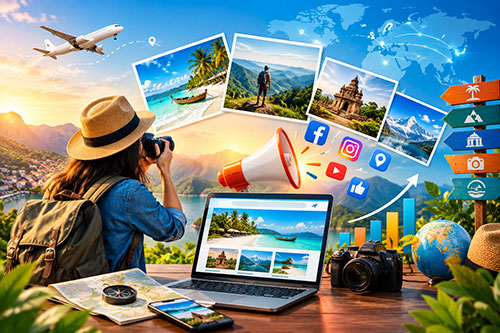
The indirect promotional activities include efforts through travel intermediaries and media. Regular advertising is made through electronic media, including television, radio, internet, e-mail. The Ministry of Tourism has developed a very informative [website] giving information about tourist attractions, facilities and commercial aspects. A related technology is CD-ROMs, and the Ministry of Tourism has developed a series of CD-ROMs which are distributed globally. Direct mailing of tourism literature and decision-makers of the multinational companies are undertaken. In this respect, there are 18 overseas offices of the Ministry of Tourism who are responsible for working out marketing strategies depending on the requirements of the specific market. These offices are primarily for servicing tourist information but are also responsible for providing information about global trends, market segments, tourist profiles of the specific region, destination features and analysing this market with strengths and weaknesses of the product, etc.
Marketing Audit is an important Marketing job which involves collection of statistical data on various aspects including the existing tourist flow, profiles of tourists, details of competitive destinations, relative market share of different destinations, country profiles, global tourism trends, etc. This is done with the help of the Market Research division of the Ministry of Tourism. All such details help to work out Marketing strategies/Plans for each identified market segment, choice of Media and monitoring and achieving the target set. The effectiveness of the marketing efforts of the overseas offices is monitored regularly through the total tourist visits generated by each overseas office from the originating markets.
One of the important objectives, as mentioned earlier, is to create tourism awareness through dissemination of tourist information correctly, quickly and conveniently. Information Technology has brought about a revolution in the way of setting new trends globally in this direction. The Ministry has drawn up an ambitious programme and introduced new IT techniques in its offices in India and abroad.
The initiatives include provision of PCs to all officers in the Ministry, provision of Internet and E-mail to all officers, creation and development of CD-ROMs/virtual destinations on destinations and subjects which are focused in the gateway journeys, Destination India, Festivals, etc. Installation of kiosks at places of tourist interest in the four metropolitan cities, installation of information on hotels & resorts at India Tourism Offices, installation of the Ministry of Tourism IVRS system in the Regional Tourist Office in India, development of database visitor information system in the National Museum and at other historical sites, etc. HARK (Handy Audio Reach Kit) in the
Marketing Strategies/Plans for each identified segment are formulated on the basis of marketing analysis. The profile of the people identified for each market segment helps to make the right choice of the media and the relevant message.
Advertising through print media is relatively less expensive and cost effective. Hence, in overseas marketing, this medium is aggressively used. Through a selective approach, those are released in the National Press, travel magazines and publications. The most important consideration for the choice of media is the popularity of that media amongst the largest groups. The unit cost and effectiveness are measured in terms of consumer responses and are other considerations in the choice of media. The frequency of advertisements and other important aspects of consideration in formulating advertisement strategy. The strategies and plans are always linked to the resources available and target set. Subject to availability of funds, the effective media is selected to reach millions of viewers. This medium presents its true colour and diversity in a compact way to a country like India to direct its impact and respond to those who are motivated clients.
Direct mail is the job of the overseas India Tourism offices and is one of the prime jobs of the overseas India Tourism offices. These offices are part of PR activity, update the list of various interest groups and mail the tourism literature to attract their attention. These are also involved in preparation of seminars, exhibitions, audio-visual shows, etc., for the benefit of the specific groups like wildlife enthusiasts, Adventure, Culture, etc.
Direct promotions are vital in international tourism marketing. These are conducted by the overseas tourist offices (list is given at the end of this chapter). Promotional events are organised jointly with airlines, tour operators, departmental stores, multinational companies, cruise liners, clubs, etc. Raffle prizes/giveaways in terms of free air tickets, free holidays at resorts are in collaboration with the State Tourism Departments/Private sector hotels. India is offered in such promotional events to attract more people to such events. Food festivals, cultural festivals, Sports events, etc., are also organised to offer varied aspects of the rich heritage of Indian Tourism.
There are a number of internationally known travel marts/shows like WTM London, ITB Berlin, ATM Dubai, PATA Marts, FITUR-Madrid, MITT-Moscow, ITB Asia Travel Mart, Singapore, International Tourism Show, Istanbul, MWTBE-Beirut, etc., where India is represented with Tourist Office in the region and Indian Travel Trade.
In the National Tourism Pavilion, India’s tourism products are displayed through digitally developed photographs, specific heritage of the country and holding interaction meetings with the Indian delegation. These Marts are also the avenues for business negotiations and renewal of travel and tourism contacts. MOUs are also signed with the Government agencies and effective coordination with airlines, Travel bodies and missions are achieved for the benefit of tourism business.
Effective liaison with media is an important and most effective tourism promotional activity. This is achieved by providing periodical news about the destination and encouraging media representatives, including television screen film teams, to visit India destinations and write about such destinations, about the facilities and services on their return to their respective countries. The media value of such reports is much more than the paid advertisements and creates greater confidence in the minds of readers/viewers.
Another important marketing effort of the overseas India Offices includes the direct liaison with the Tour Operators, Travel Agents, Incentive and Conference Operators, Adventure experts/Travel Trade Associations in Overseas Markets. These agents are encouraged to promote India holiday packages by providing financial support to bring out exclusive holiday brochures on India destinations, put up India displays in their high street location offices, support for Media and TV campaigns to boost India holidays on offer through these agencies, holding promotions with them for their clients, direct mailing to their clients the India literature covering the places in the itineraries on offer from these agents, training operational staff and organising educational tours for sales teams so that they get firsthand knowledge of the India products and can sell India destinations with perfect confidence. Even they should be recognised with some raffle prizes, giveaways and holidays as incentives.
Such programmes are regular and are organised under the Ministry of Tourism’s Media Relations and Hospitality Programme. The tourist offices help in updating the Head Office about the determination of specific products and services which are acceptable in a given market with the change in the market scene which involve a proper study of the existing goods, services on offer in relation to the existing market demands, future potential feasibility of product diversification/Uniqueness, Quality packaging, pricing and product differentiation, briefly updating on the consumer demand and working out market strategies for product positioning and involving effective communication strategies.
For example, India was promoted mainly as a cultural destination in the overseas markets. In view of the change in holiday concept in the new millennium, where the markets are now looking for such destinations where eco-friendly holidays are available and greater care is taken for protection of environment and environmental issues are given priority attention, more on health tourism with rejuvenation packages or unique experience wildlife, adventure, sports, festivals and fairs, spiritual, etc. With the educational tours, due share from these traffic-generating markets. India is being presented to the holidayers to get India’s tourism products in such market segments.
Thus, in tourism marketing, it needs constant updating. India has all the right ingredients to be a tourism product. It is not an item with fixed shape, size, content or coverage, though the tourist attraction is specific to a location. Tourism marketing is far more complex than conventional product marketing.
Marketing is an important management function of the Ministry of Tourism. Tourism being a composite service jointly provided by a multiplicity of entities, at a fixed location. In a country like India, where there is a lot of variety in Art, Culture, Monument heritage, Wildlife, natural scenic places, fairs and festivals, and a multiplicity of service providers, marketing becomes a complex exercise. The Ministry is playing a pivotal role in creating awareness about the benefits of tourism within the people of the country as well as awareness about its attractions in the tourist-generating regions. Full efforts are made to convert the awareness into actual sale or visit through appropriate motivation and follow-up. Tourism marketing is thus a two-stage activity and is often shared between the government and the private sector. The effective communication system with prospective visitors is ensured through a number of direct and indirect promotional activities. The promotional programmes which are directly addressed to consumers include – Advertising, organising audio-visual shows, exhibitions, seminars, organising promotional events jointly with airlines, tour operators, departmental stores, participation in trade fairs and exhibitions, etc.
The indirect promotional activities include efforts through travel intermediaries and media. Regular advertising is made through electronic media, including television, radio, internet, e-mail. The Ministry of Tourism has developed a very informative [website] giving information about tourist attractions, facilities and commercial aspects. A related technology is CD-ROMs, and the Ministry of Tourism has developed a series of CD-ROMs which are distributed globally. Direct mailing of tourism literature and decision-makers of the multinational companies are undertaken. In this respect, there are 18 overseas offices of the Ministry of Tourism who are responsible for working out marketing strategies depending on the requirements of the specific market. These offices are primarily for servicing tourist information but are also responsible for providing information about global trends, market segments, tourist profiles of the specific region, destination features and analysing this market with strengths and weaknesses of the product, etc.
Marketing Audit is an important Marketing job which involves collection of statistical data on various aspects including the existing tourist flow, profiles of tourists, details of competitive destinations, relative market share of different destinations, country profiles, global tourism trends, etc. This is done with the help of the Market Research division of the Ministry of Tourism. All such details help to work out Marketing strategies/Plans for each identified market segment, choice of Media and monitoring and achieving the target set. The effectiveness of the marketing efforts of the overseas offices is monitored regularly through the total tourist visits generated by each overseas office from the originating markets.
One of the important objectives, as mentioned earlier, is to create tourism awareness through dissemination of tourist information correctly, quickly and conveniently. Information Technology has brought about a revolution in the way of setting new trends globally in this direction. The Ministry has drawn up an ambitious programme and introduced new IT techniques in its offices in India and abroad.
The initiatives include provision of PCs to all officers in the Ministry, provision of Internet and E-mail to all officers, creation and development of CD-ROMs/virtual destinations on destinations and subjects which are focused in the gateway journeys, Destination India, Festivals, etc. Installation of kiosks at places of tourist interest in the four metropolitan cities, installation of information on hotels & resorts at India Tourism Offices, installation of the Ministry of Tourism IVRS system in the Regional Tourist Office in India, development of database visitor information system in the National Museum and at other historical sites, etc. HARK (Handy Audio Reach Kit) in the
Marketing Strategies/Plans for each identified segment are formulated on the basis of marketing analysis. The profile of the people identified for each market segment helps to make the right choice of the media and the relevant message.
Advertising through print media is relatively less expensive and cost effective. Hence, in overseas marketing, this medium is aggressively used. Through a selective approach, those are released in the National Press, travel magazines and publications. The most important consideration for the choice of media is the popularity of that media amongst the largest groups. The unit cost and effectiveness are measured in terms of consumer responses and are other considerations in the choice of media. The frequency of advertisements and other important aspects of consideration in formulating advertisement strategy. The strategies and plans are always linked to the resources available and target set. Subject to availability of funds, the effective media is selected to reach millions of viewers. This medium presents its true colour and diversity in a compact way to a country like India to direct its impact and respond to those who are motivated clients.
Direct mail is the job of the overseas India Tourism offices and is one of the prime jobs of the overseas India Tourism offices. These offices are part of PR activity, update the list of various interest groups and mail the tourism literature to attract their attention. These are also involved in preparation of seminars, exhibitions, audio-visual shows, etc., for the benefit of the specific groups like wildlife enthusiasts, Adventure, Culture, etc.
Direct promotions are vital in international tourism marketing. These are conducted by the overseas tourist offices (list is given at the end of this chapter). Promotional events are organised jointly with airlines, tour operators, departmental stores, multinational companies, cruise liners, clubs, etc. Raffle prizes/giveaways in terms of free air tickets, free holidays at resorts are in collaboration with the State Tourism Departments/Private sector hotels. India is offered in such promotional events to attract more people to such events. Food festivals, cultural festivals, Sports events, etc., are also organised to offer varied aspects of the rich heritage of Indian Tourism.
There are a number of internationally known travel marts/shows like WTM London, ITB Berlin, ATM Dubai, PATA Marts, FITUR-Madrid, MITT-Moscow, ITB Asia Travel Mart, Singapore, International Tourism Show, Istanbul, MWTBE-Beirut, etc., where India is represented with Tourist Office in the region and Indian Travel Trade.
In the National Tourism Pavilion, India’s tourism products are displayed through digitally developed photographs, specific heritage of the country and holding interaction meetings with the Indian delegation. These Marts are also the avenues for business negotiations and renewal of travel and tourism contacts. MOUs are also signed with the Government agencies and effective coordination with airlines, Travel bodies and missions are achieved for the benefit of tourism business.
Effective liaison with media is an important and most effective tourism promotional activity. This is achieved by providing periodical news about the destination and encouraging media representatives, including television screen film teams, to visit India destinations and write about such destinations, about the facilities and services on their return to their respective countries. The media value of such reports is much more than the paid advertisements and creates greater confidence in the minds of readers/viewers.
Another important marketing effort of the overseas India Offices includes the direct liaison with the Tour Operators, Travel Agents, Incentive and Conference Operators, Adventure experts/Travel Trade Associations in Overseas Markets. These agents are encouraged to promote India holiday packages by providing financial support to bring out exclusive holiday brochures on India destinations, put up India displays in their high street location offices, support for Media and TV campaigns to boost India holidays on offer through these agencies, holding promotions with them for their clients, direct mailing to their clients the India literature covering the places in the itineraries on offer from these agents, training operational staff and organising educational tours for sales teams so that they get firsthand knowledge of the India products and can sell India destinations with perfect confidence. Even they should be recognised with some raffle prizes, giveaways and holidays as incentives.
Such programmes are regular and are organised under the Ministry of Tourism’s Media Relations and Hospitality Programme. The tourist offices help in updating the Head Office about the determination of specific products and services which are acceptable in a given market with the change in the market scene which involve a proper study of the existing goods, services on offer in relation to the existing market demands, future potential feasibility of product diversification/Uniqueness, Quality packaging, pricing and product differentiation, briefly updating on the consumer demand and working out market strategies for product positioning and involving effective communication strategies.
For example, India was promoted mainly as a cultural destination in the overseas markets. In view of the change in holiday concept in the new millennium, where the markets are now looking for such destinations where eco-friendly holidays are available and greater care is taken for protection of environment and environmental issues are given priority attention, more on health tourism with rejuvenation packages or unique experience wildlife, adventure, sports, festivals and fairs, spiritual, etc. With the educational tours, due share from these traffic-generating markets. India is being presented to the holidayers to get India’s tourism products in such market segments.
Thus, in tourism marketing, it needs constant updating. India has all the right ingredients to be a tourism product. It is not an item with fixed shape, size, content or coverage, though the tourist attraction is specific to a location. Tourism marketing is far more complex than conventional product marketing.
Dr. Gour Kanjilal
[ Author And Tourism Representative Govt Of India ]