DOMESTIC TOURISM IN INDIA
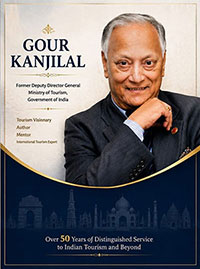
Dr. Gour Kanjilal
[ Tourism Representative Govt Of India ]
Travel for pilgrimage and learning has been an integral part of Indian culture ever since the beginning of its civilization. Several centres of learning and religious workshops developed all over the country since ancient times. This gave further impetus to the mass movement of people from one place to another. The development of traditional industries and trade created a stream of business travellers. Several trading routes were established, and traders started frequenting the centres of trade from distant places. The ancient rulers gave recognition to these travellers and created many wayside facilities like inns, sarais, dharamshalas and caravanserais for their benefit. These formed the tourism infrastructure of India in those days. Thus, India has been experiencing massive movement of domestic tourists for several centuries.
A few centuries ago, the Mughal rulers introduced pleasure tourism by building luxurious palaces and enchanting gardens in places of scenic attraction. However, during the British rule in India, domestic tourism received a new direction and meaning. The establishment of railways and export/import houses at port towns introduced qualitative and quantitative changes in Indian business tourism. In addition, the construction of guest houses, dak bungalows, forest lodges, etc., provided infrastructure for leisure and business tourism. Several railway stations were also developed during the period, which became the core of Indian leisure tourism. The emergence of a large urban middle class, coupled with better transport and communication facilities, has created a new class of holiday and leisure tourists in contemporary India. Thus, domestic tourism has become the mainstay of Indian tourism, and it is likely to grow substantially during the coming years.
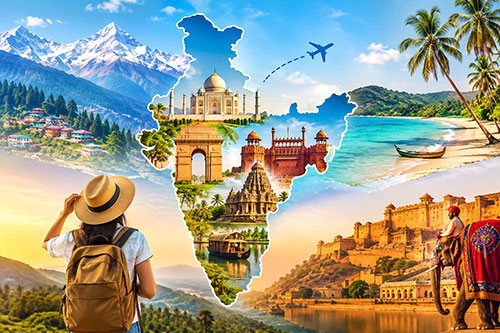
The economic, social and cultural advantages of domestic tourism are great for a country like India. These are enumerated as under:
* Domestic movement of people for non-migratory purposes constitutes shifts in consumer markets of variable importance and acts as a catalyst for the national economy.
* It has extremely high social, cultural, educational and political value and true economic value, although it is still embryonic in some cases.
* It generates large-scale employment opportunities, particularly in rural areas, and restrains the exodus of people to large towns.
* The new jobs created to meet the needs of domestic tourists have a relatively low unit cost per job, and this helps increase the number of jobs.
* Production methods for services demanded by domestic tourists generally remain simple and are based on local materials.
* It also requires only simple installations and infrastructure in transport, accommodation and catering, which take into account local culture, political traditions and historical traditions.
* It has the ability to sustain and maintain the tourism industry during lean periods of international tourism by providing an alternative for demand substitution.
* It contributes to an equitable balancing of the national economy through the redistribution of national income and thus provides a better environment for the growth of both domestic and inbound tourism.
* It is a single unifying force that helps to achieve understanding between various linguistic, religious and commercial groups living in different parts of the country. It thus contributes towards strengthening the fabric of national unity and cultural integration.
In general, the economic and social well-being of a nation is reflected in the magnitude of domestic tourism in the country. It manifests itself in the most vibrant form where people are free to move from one place to another for purposes of pleasure, education, experience, religion and business. The phenomenon of domestic tourism is thus a conspicuous expression of the way of life in any society.
Domestic tourism has already become a phenomenon of great significance in India with the emergence of a sizeable middle class with reasonable affluence and disposable income and a strong desire to travel within the country, coupled with improved transport and other infrastructure facilities. It is now further accelerated with the introduction of leave travel concessions granted to government employees as an incentive, which has boosted domestic tourism. The economy of the hills, particularly Kashmir, Himachal Pradesh, Garhwal and Kumaon, is overwhelmingly dependent on tourism and particularly on domestic tourism. Similarly, the beach resorts of Goa, Maharashtra, Kerala, Tamil Nadu and Orissa are frequented by domestic tourists round the year and contribute to the local economy.
The decision adopted at the World Tourism Conference held from September 27 to October 10, 1980, at Manila (Philippines), which is known as the Manila Declaration, describes the significance of domestic tourism in the economic and social context as under:
“With each country, domestic tourism contributes to an improved balance of the national economy through a redistribution of the national income. Domestic tourism also heightens the awareness of common interest and contributes to the development of activities favourable to the general economy of the country.”
“The right holidays, the opportunity for the citizen to get to know his own environment, deeper awareness of his national identity that links him to his compatriots and the sense of belonging to a culture and to people are all major reasons for stimulating the individual’s participation in domestic and international tourism through access to holidays and travel.”
“Social tourism is an objective which society must pursue in the interest of those citizens who are less privileged in the exercise of their right to rest.”
In its report of August 2001, the WTTC India Initiative Document mentioned:
“The burgeoning domestic demand needs to be satisfied by facilities matching international standards in price and quality. This is necessary as much to keep the domestic demand at home as to entice foreign tourists to India. The travel demand by tourists must be matched with adequate facilities in utilities, parks, museums, sanctuaries, adventure camps, entertainment centres, and resort areas that are designed, developed and planned to cater to tourists, both foreign and domestic.”
“India is home to many of the leading religions of the world. Hinduism, Buddhism, Jainism, Sikhism. It is also home to sizeable followers of Islam and Christianity.” The states of Uttar Pradesh, Andhra Pradesh, Tamil Nadu, Karnataka, Bihar, Maharashtra, Rajasthan, Jammu & Kashmir, West Bengal and Himachal Pradesh attract visitors in millions.
“An event of note is that the Kumbh Mela, occurring once in twelve years, attracted more than 68 million visitors in 2000 in Allahabad, making it the largest international event other than Haj.”
Such observations from tourism expert bodies are enough to reinforce the fact that domestic tourism is of immense importance to India, and domestic demand will grow year after year with growing business traffic and disposable income.
In fact, domestic tourist demand will increasingly shift to the more expensive range and become the primary consumer of the tourism market.
Dr. Gour Kanjilal
[ Tourism Representative Govt Of India ]