AVIATION IN INDIA : AIRLINES & AIRPORTS - NEW CHALLENGES OF 21ST CENTURY ECONOMIC IMPERATIVES
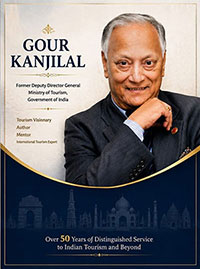
Dr. Gour Kanjilal
[ Author And Tourism Represtitive Government Of India ]
A) IMPORTANT ENGINE FOR ECONOMIC GROWTH
In the global and Indian scene there is rapid economic changes.
In this scenario, Civil Aviation is recognized an important vehicle for economic growth.
Over 2000 million passengers globally per year use airlines for leisure & business travel.
Around 40% of the worlds manufactured goods by value are transported by air only.
B) REVENUE GENERATION
Aviation industry contributes substantially in national exchanger through taxation by Central, State and Local Govts around the world. Passengers, Cargo handlers, pay Taxeson air tickets & cargo consignments, service charges, FBTs etc.
Employees pay income taxes on their salaries
C) SPIN OFF BENEFITS
Opens up new markets.
Help in the growth in International trade.
Roads, communications.
Infrastructure development.
Boost tourism & travel business.
Specialists in aviation related activities - Insurance, Surface transport etc.
D) EMPLOYMENT OPPORTUNITIES
The Aviation industry at a rough estimate creates about 30 million jobs & 50% estimated to be direct employment.
Proper research is needed to have right figure about employment opportunities.
Aviation is the main link for boosting of tourism.
Nearly 98% of outbound travel is by air
Similarly about 90% tourist arrivals in India by air.
In the present context with the liberalized open sky policy and introduction of low budget airlines, no frill airlines, domestic tourism has seen a big boom and many new areas have been opened up for tourism activities.
Domestic air travel increased by more than 25% last year.
- Open Sky Policy has also increased seat capacity and this boosted international tourism arrivals.
* International travel increased by nearly 15% last year. Seat Capacity in the major traffic generating markets during peak season was bottle neck for tourism growth.
* With growth of tourism, it has contributed & boosted India’s GDP.
* It is estimated tourism contributed 5.8% in countries over all GDP.
* Tourism linked with aviation industry can help in increasing foreign exchange earnings, foreign exchange earnings 16% growth ($5 billion in 2005).
* Tourism is the largest sector in the world wide export of good & services.
* At over $560 billion, it is larger than automatic, chemicals, fuels & other sector.
* Tertiary/ supplementary benefits of tourism are huge.
* The Satellites accounting figures of world travel & tourism council suggest that $ 11.33 billion travel & tourism industry in India (2000) supported a $ 23.8 Billion travel & tourism related industry.
* Tourism backed by Civil Aviation can create more employment - Tourism with lower investment generates more jobs than any other industry in the world.
* As per WTTC, the travel & tourism economy in India which includes aviation, Hotel, Entertainment, transport etc. currently account for 17.4 million jobs in India or 5.8% of total employment.
* This has potential rise to 25 million jobs or 6.8% of total employment by 2010.
* Tourism & Aviation links thus bring real economic efficiency.
DEMAND SUPPLY GAP IN THE AVIATION INDUSTRY
* India ranks quite behind in terms of global tourist arrivals.
* India receives a meager 0.39% of the world tourist arrivals.
* India receives a mere 0.68% of world tourism receipts.
* India is ranked 140th for contribution of travel & tourism industry to GDP.
* Huge potential for future development if proactive policy is evolved.
* Charter flights needed to plug in demand supply gap. Increased Inbound/ outboundcan solve the imbalance.
GROWTH POTENTIAL
* International Civil Aviation Organization has projected India is the fastest growingmarkets in the world.
* Both in passenger & cargo traffic (average 7% growth) is estimated.
* Domestic traffic accounts for almost over 60% of total average traffic and is maintaining this increased trend and this positive trend to continue.
* Open Sky Policy and with private airlines in operation, there is real boom in domestic traffic.
* Domestic airlines increased from only one a few years ago to more than 10 in 2006. More to follow. Already heavy investments they are making for purchase of new aircrafts.
* Growth potential is there for Cargo export about 6 lakh tons of international cargo handled (in 2002) and have great potential if airport infrastructure is improved.
* Due to decrease in airfares (almost by 40 % on last year) to boost domestic travel has increased enormously with many new areas.
* Also the booming economy with GDP increase & disposable money more people travelling by air.
* Many domestic airlines are also operating on international routes.
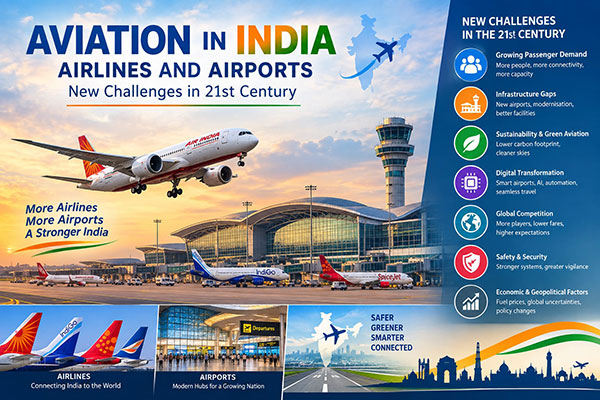
BOTTLENECK AREAS AFFECTING GROWTH
( BOTH PASSENGER & CARGO DEVELOPMENT )
- Capacity constraints - from many emerging markets (South America, CIE countries).
* Lack of proper aviation infrastructure.
* High Airport charges (landing, Navigation, Parking charges).
* Initiatives to have better route distribution agreement and non utilization of seatcapacity which is available due to bi-lateral agreements.
* More Domestic/Private Airlines be permitted to fly internationally to areas like Iran, Turkey, Sweden, Middle East, where we lack of air - connectivity.
* Foreign Nationals when will use those airlines will help in earning more foreign exchange for the country.
* Smaller aircraft & Helicopter services for remote areas operations, point to pointservice such operations can boost tourism to hinterland areas (specially North East).
* Domestic Hubs & International Hubs concept need to be introduced. Mumbai beconverted into International Airline Hub by treating it as Special Economic Zone. Fuelcan be provided at international prices.
* This will encourage many international flights to touch down in India.
* This will help increased tourist arrivals & will provide improved connectivity.
* Advantage is now goes to Dubai which is real hub for international airlines, where as India can take this position.
* For domestic sector also airline can have maximum operational efficiency & financial gains through Hub-Spoke (Feeder route). Connectivity concept, Nagpur, Hyderabad, Bhubaneshwar, Bhopal & especially Nagpur can be considered for this Hub spoke concept. This will improve domestic connectivity.
TOURISM CHARTERS
A) ECONOMIC BENEFITS
- Multipliers effect on India's’ GDP, since earnings will remain in India
* Increased revenue - in the form of airport taxes landing & take off charges, serviceproviders charges etc.
* Employment generation, sales & reservation agents, ground supporting staff, pilots,cabin crews. They will pay taxes from salaries & thus more revenue generation.
* Benefits to customers - Lower rates
* Revenue through packages selling by travel agents
* Charters will carry passenger who book prepackages (with air fare, Hotel etc.) - Demand for domestic airlines so more airlines to come over time.
* Already instead of one domestic airlines few years back, in have now over
B) IN BOUND TOURIST CHARTERS
* With liberalized Policy more charters to time to India.
* More airports will be developed with facilities for charter landings.
* Carrying Indian to inbound charters has helped as lot of Indians like to visit India.
* Whereas earlier they used to take charters to other countries.
* Tourist charters are now allowed at 40 airports. Where improved charter handling facilities are being developed.
AVIATION INFRASTRUCTURE
A) ACTION PLAN – IMMEDIATE
Implement privatization of all major airports & allow private investments. (work now initiated)
* Proper environment for investors to derive adequate returns of their investments.
* Revenue from Civil Aviation to be utilized for developing Civil Aviation infrastructure.
* Single Agency Security system for effective control - multi agency is real problem.
* Landing & Navigation costs to be rationalized. Parking fees, Refueling charges etc.need to be reduced.
* Sales tax on ATF, Surcharge on ATF, lot of taxes but no commensurate facilities.
* Separate terminals for long haul, medium haul & short haul are needed.
* Modernized them with latest technology. Allow foreign investments.
* Only 40/50 airports are at present all weather airports. These are to be utilized to itsmaximum capacity airports of Surat, Baroda, Nagpur, Raipur, Bhuj are underutilized.
* Leh, Kullu, Kargil are to be fully utilized during season. Airport facilities improved.
Defence regulated airports to be utilized for tourism purposes like Goa, Jaisalmer, etc. Also setup new airports on Build/own operate airport bypassing restrictions.
d) MODERNIZATION OF AIRPORT INFRASTRUCTURE
Proper signages at airports - use international symbols.
Fast track service on pre-payment basis “Swagatam Service” on the lines of Maharaja Service in UAE - on some pre fixed fees.
Provision of interaction Kiosks/Business centers.
In good number of Immigration counters
Toilets (facilities for physically challenged)
Duty free Shops
Health services/chemists
Meditation/Prayer Hall
Install all electronic scanners for passports & electronically readable disembarkation cards
Separate immigration counters for NRIs/old & ladies with babies
Departure Terminal
Fast Track service for business travelers
Link between domestic & international terminal (good coach service) preferably rapid rail service.
Food courts
Parking Announcements both.
Taxes - Tax Holidays - Airlines to be treated as infrastructure
Airport Officers - Tourist office, airlines, banks, insurance rail agents etc. to cover needs of passengers
Conference Hall
VIP Rooms
Restaurants
Lifts (Heavy load bearing) from. Can parking levels to Dep./Arr. terminals
Left Luggage Rooms
Visitors waiting lounge
All such essentials which give real modern image of the airport.
Airport is country’s first impression
Work with the image of quality, efficiency, service and comfort
No compromise on security and easy movements
Many exchange counters
Inter State Bus Terminals (for long journeys giving connection to various States)
Florists Airlines - VIP Lounges (1st class Passengers)
* AAI - VIP Lounges - where passengers can fill up “Embarkation” - The concept is to have city airport where one can do business without coming to city.
* A vision & will is needed to bring this change.
There should be no concern about safety of flights. All operators that come to India have the Air operator's Certificate issued by their respective authority, and DGCA's safety and security concerns are only as applied to foreign airlines.
DGCA role should be only to give flight clearance of a series of non-scheduled flights for tourist charters, and normal oversight as applicable to foreign airlines aircraft.
1. There should be no restrictions in terms of number of international charter flights by an operator and passengers flown into India as long as they do not follow a fixed schedule and are in compliance with the relevant ASA.
2. The passengers on charter flights will not be restricted to those that have bought an Inclusive Tour Package (ITP).
3. Incoming charter aircraft will be free to land at any Indian airport that has Customs and Immigration facilities.
4. Charter operators do not need to take any prior permission from DGCA, as long as they have filed the flight plan with ANS and have a confirmed landing slot at the relevant airport.
5. Passengers coming on an inbound charter flight will be free to shift to scheduled carriers for travel within India or abroad and vice versa, without seeking permission from DGCA as required in the present regulations.
6. There should be no restriction on the number of observers of the principal tour operators who come with the charter flight to oversee the arrangements. This is the prerogative of the principle tour operator.
7. Online filing of applications should be introduced with automatic clearance within three days for both incoming and outgoing charter flights.
8. Self-ground handling by the tour operators or its nominated GHA must be allowed at all airports, including PPP and AAI airports. At airports under joint use of Defense and civil purpose, self-handling in the terminal building limited to baggage handling and passenger facilitation must be allowed to provide economy and efficiency.
Besides the above, we would like to give following recommendations for including in the Civil Aviation Policy which will encourage international tourist arrivals to our country through charter operations:-
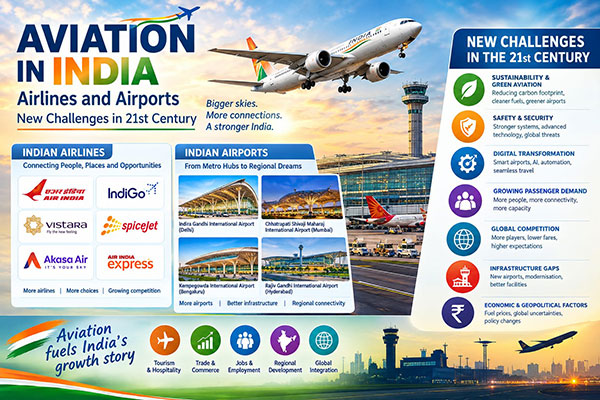
AIRPORTS
1. All international airports and immigration counters in India should have the facility of biometric facility and it should not be mandatory for the tourists to have biometric formalities at the Indian Embassies/consulates abroad so that tourists are not harassed and e-Tourist Visa and normal Visa holders do not waste time.
2. There should be rule of Uniform Parking Charges/fees at the airports whether run/managed by Airport Authority of India or Private Operators. Fee should be controlled by the government for tourist coaches and cars. Proper parking area should be designated which should be dedicated for tourist vehicles and minimum inconvenience to foreign tourists and no additional pick up charges should be levied at any airport on tourist vehicles. Tourist should be able to board the vehicle without crossing the roads.
3. Unutilized air strips in tourist circuits and the Himalayan ranges and these are to be made operational for religious and adventure tourism.
4. Air ambulances to be kept at all the major airports and also in the North East and all remote air fields for the safety of tourists.
5. Entry passes at the airport should not be more than Rs. 5000 to 10000 for six months for all the Ministry of Tourism, Govt. of India recognized tour operators.
6. IATO as the apex body of tour operators, should be provided free counter at the major airports to help and facilitate international tourists.
7. There should be a separate area earmarked for local tour operators/ travel agents to receive foreign tourists and welcome them. By providing correct signages to direct the foreign tourists to this area will increase their safety and they will not be fleeced by the touts.
8. Welcome to India signage to be placed in major international languages at all the international airports.
9. To ensure total safety & security of air transportation by introduction of state of art air technology, equipment and training facilities.
10. There is a need to have a clear and forward looking policy on ground handling services by opening this sector for enhancing competition in the services by allowing professional ground handlers with international experience.
11. A forward looking Green Field Airport Policy, which encourages the investors and developers to setup more green field airports in the country.
12. A clear sky policy to encourage the commercial activities at the airport for optimization of revenue from Non-Aeronautical Services.
AIRLINES
13. Just like the government have regulated cab/taxi fares from airports and other places, similarly UPPER capping of air fare has to be fixed so that during the peak season tourist and passengers are not overburdened with high air fare.
14. The baggage allowance on domestic flights for all international tourists should be at least 20 kgs. so that tourists are encouraged to buy Indian
Handicrafts and Souvenirs and do not face hardship when they connect from international flight to domestic flight and put to any inconvenience.
15. Special incentives should be given to regional airlines who link up remote tourist destinations.
16. In Goa, AAI is forcing Charter Airlines to be handled by Air India only. Even charter flights of Schedule Operators are asked to be handled by Air India, who do not have proper services and also charge two times the handling rate of Private Handling Companies. This is discouraging Charter Airlines to come to Goa. The charter policy must give freedom to Aircraft Operator to choose its ground handling agency from the available GHAs at the airport of call and not create monopoly of any single airline.
CHARTER POLICY
17. It is high time that the Indian government liberalizes Air Charter Policy and the charter flight should be allowed to carry Indian passengers both ways to make these flights commercially viable and this will be beneficial to Indian traveller also financially. Charter landing fee for charter flight should be less then schedule flights because they are taking risks to encourage charters.
18. Airports Authority of India has increased the Security Deposit of Rs. 1 Crore against Slot allotment at Dabolim Goa. This has adversely affected Tourist Charter operators as well as airlines. This should be withdrawn. This year the charters have gone down due to this reason.
19. Tourist Charter guidelines needs to be amended in line with Government of India efforts to promote tourism to India including e- Tourist Visa.
FDI and Taxes
20. Tax exemption in line with IT sector which gets tax holidays because of its potential to bring Foreign Exchange, investment in aviation sector also should get a tax holiday at least for the initial 10 years.
At last government has looked into Regional air-connectivity part and government’s UDAN Policy has made a big impact on regional connectivity.
Dr. Gour Kanjilal
[ Author And Tourism Represtitive Government Of India ]