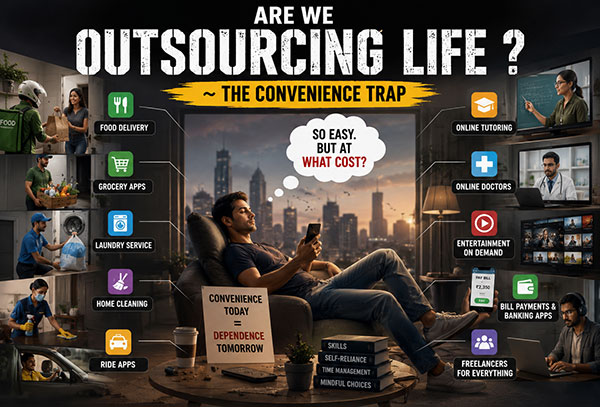
ARE WE OUTSOURCING LIFE ? ~ THE CONVENIENCE TRAP
Writer Dr Gour Kanjilal
India Is Becoming Richer. But Are We Losing Touch With Life Itself ?
India today is more convenient than ever before.
Groceries arrive in ten minutes. Food appears at the door without anyone entering a kitchen. Drivers ferry children to school. Domestic help walks the dogs. Maids clean homes, pack school bags, supervise homework, and sometimes even raise children emotionally.
On the surface, this looks like progress. And in many ways, it is.
But increasingly, I wonder whether we are slowly outsourcing not just labour — but life itself.
The other morning, at 7 am, I saw a young child being dropped to school by a driver and maid. The child was asleep in the back seat.
Perhaps the school starts too early. Perhaps the parents were busy. Perhaps both parents work demanding jobs.
But the image stayed with me.
When did we stop dropping our own children to school ?
Not because it is efficient. Not because it saves time. But because it is one of life’s simplest rituals.
The morning conversation.
The hand held while crossing the road.
The last-minute reminder about homework.
The silly jokes.
The shared silence.
These are not “tasks.” They are memory-making moments.
And increasingly, we are absent from them.
The same thing has happened with dogs.
Across Indian cities today, dogs are often walked by “dog boys” — hired handlers who take multiple pets out together while the owners remain inside their homes.
Again, there is nothing morally wrong with this. Urban life is busy. People need help.
But somewhere along the way, we forgot that walking a dog is not merely pet maintenance.
It is therapy.
It is routine.
It is exercise.
It is bonding.
It is the rare moment in modern life where a human being slows down and simply walks.
Many Westerners who visit India are often astonished by this aspect of upper middle-class urban life. Ironically, while many Indians believe they are emulating the West, the reality is often the opposite.
In most Western countries, people do their own chores.
They walk their own dogs.
They grocery shop themselves.
They cook.
They clean.
They drive their children to school.
Children often walk to school.
Families assemble furniture together.
Teenagers work part-time jobs.
Adults mow lawns, wash dishes, and carry their own shopping bags.
Not because they cannot afford help — but because participating in ordinary life is considered part of being human.
In India, however, success increasingly means insulation from ordinary life.
A successful person is often someone who never enters a supermarket, never cooks, never drives, never cleans, never waits in line, never walks anywhere, and gradually loses all contact with the mechanics of daily living.
Convenience has become a status symbol.
But there is a hidden cost to this model.
When every inconvenience is removed, many of the small grounding experiences that give life texture disappear too.
The supermarket is not just about buying groceries. It teaches patience, decision-making, budgeting, social interaction, and even family negotiation.
Cooking is not just labour. It is creativity, nourishment, culture, memory, and care.
Cleaning your own space creates respect for labour.
Walking to places connects you to your neighbourhood, weather, people, sounds, smells, and reality itself.
Doing small tasks keeps a person psychologically anchored to life.
And perhaps this is why so many affluent urban Indians today feel strangely exhausted despite being surrounded by convenience.
We have optimized life so aggressively that we have removed participation from it.
Technology companies celebrate “frictionless living.”
But some friction is necessary.
Without friction:
children become disconnected from parents,
parents become disconnected from routines,
families become disconnected from each other,
and people become disconnected from the physical world.
The irony is that while India modernizes economically, many people around the world are moving in the opposite direction culturally