CRUISE TOURISM
CRUISE TOURISM
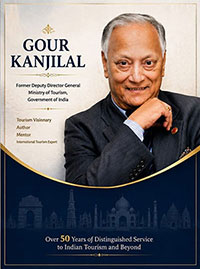
Dr Gour Kanjilal
[ Author And Tourism Representative Government Of India ]
Introduction
Cruise Shipping’ is one of the most dynamic and fastest-growing components of the leisure industry worldwide. It is fast emerging as a new marketable commodity/product. Growing at the rate of 12% per annum globally, this sector has witnessed some activity in India as well in recent times. However, it is still in its infancy in India.
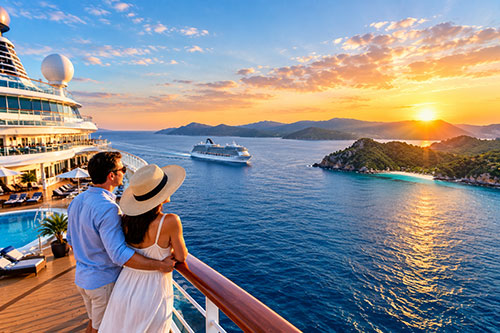
Cruise ships are like moving townships, equipped with state-of-the-art facilities and a variety of recreational activities. The idea is fast catching on, as a journey aboard cruise liners is not only pleasurable but also comparatively free from sea-travel health hazards.
Experience in the Caribbean, Latin American and South-East Asian countries indicates that a huge amount of foreign exchange can be earned and employment can be provided onshore by creating the right policy environment and infrastructure for the growth of cruise shipping.
Cruises are no longer considered the privilege of the rich and the elderly. Today, more and more young tourists are cruising. This industry annually generates US$ 14 billion worldwide and enjoys a passenger base of over 10 million, which is expected to almost double by 2009. As regards the number of cruise ships, projections/forecasts indicate that the number will increase from the present 257 to 285 by 2009.
India, with its vast and beautiful coastline, virgin forests and undisturbed idyllic islands, rich historical and cultural heritage, can be a fabulous tourist destination for cruise tourists. With the Indian economy developing at a steady pace, the middle class growing in number and increasingly possessing disposable incomes that could be spent on leisure activities, Indians could also take up cruise shipping in a big way.
Current Status
While the growth rate witnessed globally in the cruise shipping sector, in terms of cruise ship fleet and passengers carried, is in the range of 10%–20%, the Indian coastline is not witnessing the same growth pattern.
At present, no Indian shipping line owns any luxury cruise liner. As regards the trend in cruise passengers from foreign lines landing at Indian ports, it may be seen from the Statement at Annexure-I that the number of cruise passengers has been increasing since 2004–2005.
Perhaps the fastest-emerging product in the leisure industry, cruise shipping requires a special marketing strategy and focus.
Economic Benefits of Cruise Shipping
The principal beneficiary of ‘cruise shipping’ is the economy of the respective maritime nations where the cruise vessels call. Cruise shipping, worldwide, is seen as an employment-generating leisure activity.
It is estimated that, on average:
- A cruise tourist spends about US$ 200–300 per visit.
- A cruise staff/officer spends about US$ 100–150 per visit.
Besides, a vibrant ‘Cruise Shipping’ sector has a number of spin-off effects in the service sector.
On average, about 1,000 passengers travel on a medium-sized cruise vessel. When such vessels arrive at a port, there is automatically a demand for a whole range of services.
For instance:
- Temporary stalls are erected at the berth/wharf to sell traditional handicrafts, souvenirs, etc.
- These are very popular among cruise tourists.
- In some cases, chartered flights are engaged.
- Tour buses are engaged to transport cruise tourists.
- The services of guides and local tour operators, besides vessel agents, are also availed.
- Passengers spend considerable amounts on traditional handicrafts, dresses, etc.
- Cruise tourists also pay admission/user charges at monuments of historic significance.
Thus, a cruise call results in gainful employment for a large number of people, and the earnings could be in foreign currency if the cruise tourists are foreigners.
Cruise ships also require:
- Bunkers
- Provisions
- Bond stores in large quantities
- Agency services
- Crew and other services
All these demands can be met locally. To that extent, there will be a contribution to the Indian economy.
Thus, cruise tourism can be seen as a new and popular leisure activity generating employment, local growth and foreign exchange earnings. As such, the nation stands to gain substantially by promoting cruise tourism.
Potential in the Indian Context
Cruise tourism has tremendous potential in India. There is a definite curiosity value attached to this sector since it is a relatively new concept for Indian travellers and is mostly seen as a luxury item.
If cruising is made more affordable and the opportunity becomes available in India, the vast Indian middle class could provide a huge pool of clients and a substantial market.
An important aspect of cruise tourism activity is that cruisers/liners look for newer destinations. The world’s most favourite cruising areas, i.e. the Caribbean, Mediterranean, Alaska and the latest additions in South-East Asia, have been saturated for quite some time. Newer areas could be points of attraction for the ever-increasing fleet of cruise ships/tourists.
In this backdrop, there is tremendous opportunity for the Indian Ocean region. India, with its large coastline and varied, unspoiled tourist destinations, all of which can be explored for cruise shipping by visiting any of our seaports, makes it an ideal place for marketing cruise shipping/tourism to both domestic and international clients.
Problems/Bottlenecks
Despite the inherent advantages, economic benefits and tremendous potential of the ‘Cruise Shipping’ sector, the country has not witnessed any worthwhile growth compared to the growth witnessed in Latin America and South-East Asia in this segment.
Cruise shipping is an international industry, and its efficiency, judged by the contribution it makes to the country’s economy, is governed by the industry structure, infrastructure and policy package in place.
Various relevant components are:
- Stated policy on cruise shipping covering various aspects.
- Well-developed port infrastructure and cruise terminals.
- Availability of cruise liners.
- Conducive fiscal regime.
- Hassle-free immigration and transit facilities.
- Marketing strategy.
- Connectivity to onshore destinations by various modes:
- Road
- Rail
- Air
- IWT
- Duty-free bunkering.
- Institutional framework for the holistic development of cruise shipping.
The ‘Cruise Shipping Policy’, as outlined below, attempts to address each of these aspects and seeks to develop cruise shipping in India at a fast pace.
Objectives
The objectives are:
- To develop India as a destination as well as a source market with state-of-the-art infrastructure and an appropriate marketing strategy.
- To increase the number of cruise ship calls and passenger arrivals in a sustainable manner.
- To achieve a target of at least 10 lakh cruise passenger landings per year by 2010.
- To strengthen inter-sectoral linkages whereby cruise liners source the requisite supplies of goods and services from local Indian suppliers.
- To consolidate existing ports of call and explore other ports and suitable anchoring sites on the Indian coast, with a view to making additional cruise ship calls to other areas of the country.
- To operationalise appropriate promotional programmes that would effectively convert cruise passengers into long-stay visitors.
- To maximise the benefits from the cruise industry consistent with the protection of the environment.
- To ensure that the cruise shipping industry in India becomes internationally competitive with other destinations and contributes to the economy in terms of the generation of foreign exchange, income, employment and business opportunities.
- To attract the right segment of foreign tourists to cruise shipping in India.
- To popularise cruise shipping among Indian tourists.
- To enhance the absorptive capacity of the country by developing existing and new visitor attractions, including event attractions, in line with India’s efforts to improve the tourism product.
POLICY ISSUES: INDIA AS A DESTINATION MARKET OR SOURCE MARKET?
Given the rich cultural heritage, a number of scenic spots and the variety of flora and fauna in proximity to the ports, India is a potential candidate for destination brand development as well.
Given the vastness of the country, the fact that the Indian economy is growing at an impressive annual average growth rate of more than 8% per year, and the fact that India is the 4th largest economy in PPP terms, the country is poised to become a major source market for cruise shipping, provided, of course, that the right policy environment is in place.
Thus, India should be promoted both as a destination and source market.
The importance and potential of India as a destination market should be driven home through India’s participation in international exhibitions and trade fairs on cruise shipping on a continuous basis. Destination brand development may be attempted by promoting India as a region.
Source market development may take place through:
- Economic surveys
- Proper segmentation of the market
- Marketing efforts
- Positioning cruise as an aspirational product
- Proper pricing of the product within the country
WELL-DEVELOPED PORT INFRASTRUCTURE AND CONNECTIVITY
A phased programme will be evolved for the development of facilities at ports for cruise shipping.
The ports will avail of the financial assistance available under the scheme of the Department of Tourism for funding tourism projects, wherein assistance of up to 25% of the project cost, subject to a ceiling of Rs. 50 crores, is provided by the Ministry.
Notwithstanding the above, if any major/non-major port is able to attract a BOT operator to invest in infrastructure facilities, the port will be encouraged to develop such facilities.
Necessary infrastructure such as:
- Rail and road connectivity
- IWT connectivity
- Air connectivity
- Metro connectivity
will be developed.
Individual ports identified in this policy will plan to develop suitable infrastructure. However, the cruise shipping policy will provide comfort to future investors for committing resources, etc.
Ports shall augment financial resources to develop cruise terminals/infrastructure in order to have more calls from cruise liners.
Private agencies interested in developing cruise terminals shall also be encouraged to do so at cruise destinations. Central Government/State Government/UT Administrations shall provide financial resources and other incentives for promoting cruise tourism.
Efforts shall be made for the development of marinas for yachts and small boats at all important coastal tourist destinations like Goa, Cochin, Chennai, etc., based on the BOT/PPP model wherever possible.
ABSENCE OF INDIAN-FLAG CRUISE VESSELS AND CABOTAGE RELAXATION
Cruise vessels under the Indian flag will be promoted. Presently, no Indian shipping line owns any luxury cruise liner. The policy dispensation being prescribed vide this document is expected to lead to Indian-flag cruise liners becoming a reality in the not-so-distant future.
However, until that happens, foreign cruise liners must be encouraged to undertake coastal runs. Moreover, since India is intended to be promoted as a region, it is imperative, given the present situation when there is no Indian-flag cruise liner, that foreign cruise lines touch more than one port.
As per Section 407(1) of the MS Act, no ship other than an Indian ship, or a ship chartered by a citizen of India or a company or cooperative society that satisfies the requirements specified in class (b) or, as the case may be, clause (c) of Section 21, shall engage in the coasting trade of India except under a licence granted by the Director General under this Section.
This puts restrictions on foreign lines embarking passengers/disembarking along coastal runs.
Efforts will be made to attract investment for Indian-flag cruise liners.
Foreign-flag cruise ships/vessels will be permitted to make coastal voyages between different ports of India in relaxation of the provisions of Section 407(1) of the MS Act.
This dispensation, i.e. cabotage relaxation, presently given till December 2008 under Section 407(3) of the MS Act, will be extended for another 10 years.
IMMIGRATION OF CRUISE TOURISTS
Cruise ships may involve 1,000–2,000 passengers at a time. Disembarkation involving a large number of immigration formalities can not only spoil the mood of the tourists but also give negative publicity to the country as a whole.
Hence, it is imperative that immigration formalities are completed quickly and within one hour. This will be ensured through appropriate procedures for the disembarkation of passengers from the ship.
QUARANTINE
The Indian Port Health Rules, 1955, govern quarantine restrictions for passenger ships as well as cargo ships.
In view of these Rules, for the purpose of dealing with diseases such as Cholera, Plague and Yellow Fever, Indian Port Health quarantine restrictions are in place to tackle public health emergencies like SARS.
In 1951, WHO adopted International Sanitary Regulations, which were renamed in 1969 as International Health Regulations (IHR), for the purpose of disease prevention and to ensure maximum security against the international spread of disease without unnecessarily interfering with international traffic.
The existing IHR covered the spread of three diseases:
- Cholera
- Plague
- Yellow Fever
In the revised IHR, the spread of these diseases is being made mandatory for notification. Besides, haemorrhagic diseases such as Congo fever, Cholera, Plague and Yellow Fever will be notified based on assessment.
In view of the above, it seems that adequate measures are available for the security of cruise passengers through the Port Health Rules as well as International Health Regulations.
It, therefore, does not appear necessary to frame separate rules for this purpose. However, the Indian Port Health Rules, 1955, should comply with the International Health Regulations, as relevant to cruise shipping, from time to time.
CUSTOMS
Customs clearance will be provided at customs-notified ports for disembarking/embarking cruise tourists, subject to the provisions of the Baggage Rules, 1998.
Further, transfer of baggage between airports and seaports under bond would be permitted by Customs authorities, subject to the provisions of the Customs Act, 1962.
WASTE DISPOSAL
The cruise liners will be mandatorily asked to comply with all requirements of the Marine Pollution (MARPOL) Convention and its annexes and to follow the guidelines of the Indian Maritime Administration to ensure, inter alia, the following:
- Solid waste, wastewater, contaminated water or used oil will not be released into the sea or on islands during the cruise ship tour in Indian waters.
- Any boat or smaller vessel taking tourists to an island destination in India will ensure that no litter or waste is thrown overboard or left littering the island.
- All waste originating from the mother ship will be disposed of in a manner stipulated by the Maritime Administration.
- No oily or contaminated bilge water will be released in Indian territorial waters except in emergency situations where the safety of the vessel or those aboard would be threatened.
CONDUCIVE FISCAL REGIME
The fiscal environment, governed by the incidence of taxation, should be conducive to encouraging cruise ship itineraries in Indian ports on the one hand and encouraging domestic tourists to avail themselves of a variety of entertainment/services on board cruise ships or on domestic circuits on the other.
Duty on Bunkering
The Customs duty on bunkering for coastal (cruise) ships is presently around 33%.
Therefore, a foreign-flag vessel, if it is not engaged in coastal trade in India and purchases bunker in India, has a bunkering cost that is 33% cheaper compared to the purchase of bunker by a vessel having the Indian flag or a foreign flag engaged in coastal trade in India.
This makes cruise shipping operations in Indian waters highly uncompetitive.
Taxes on Facilities/Services Provided by Cruise Ships
Various types of facilities/services such as:
- Restaurants
- Bars
- Discotheques
- Swimming pools
- Duty-free shops
- Jewellery shops
- Sauna baths
- Massage parlours
- Beauty parlours
are provided on board cruise ships.
At present, these facilities/services attract the following taxes/duties.
Service Tax
Service tax, levied by the Central Government, applies to services such as massage/beauty parlours and sauna baths of cruise ships on a coastal circuit.
Taking these activities into consideration, the service tax concession would be a minor concession; however, it would help the cause of cruise shipping promotion.
Entertainment Tax
Entertainment tax is levied by the State Government.
Since States are direct beneficiaries of cruise passengers consuming a variety of services on the ships, the State Governments would be urged not to levy entertainment tax on these activities on board a cruise ship, perhaps by bringing about amendments in their respective State statutes.
Duties on Goods
Duty-free shops on board a foreign cruise vessel are required to be sealed when they convert to the coastal leg.
Such an act may become an irritant for passengers and would be undesirable for them. However, duty-free goods continue to be provided to passengers.
The Central Government will establish an appropriate fiscal regime for cruise shipping consistent with the overall fiscal policy of the Government. Anomalies, if any, will be addressed through the budgetary process.
CRUISE TOURISM PROMOTION
The Ministry of Tourism will prepare cruise shipping itineraries in consultation with State Governments, popularise theme cruises by State/Central PSUs and undertake appropriate publicity campaigns.
Government/PSUs are providing Leave Travel Concession (LTC) facilities to their employees on the underlying principle that they should be encouraged to take a break from work and indulge in leisure as a popular leisure activity.
In so much as cruise shipping is fast emerging as a popular leisure activity, the Government would include cruise shipping itineraries in India offered by luxury cruise liners as a permissible mode of travel/destination under the LTC scheme.
MARKETING STRATEGY
Cruise shipping is a new product in the Indian context. This new product needs to be developed and marketed, and for that purpose an effective institutional framework is a must.
In fact, the institutional framework will hold the key to the success of this new product.
Some of the major marketing challenges in the cruise shipping development process are:
- Idea generation
- Screening
- Concept/brand development
- Business analysis
- Product development
- Brand positioning
- Source market development vs. destination market development
- Market testing
- Commercialisation
PROCEDURE FOR HASSLE-FREE, QUICK AND TIMELY IMMIGRATION
The following procedures are proposed:
- The cruise shipper should send the details of all passengers at least seven days in advance to the respective immigration authorities.
- As regards passengers who are arriving without visas, the Visa Manual provides for the grant of a collective landing permit (TLP) with multi-entry facility for a group of four or more for a period not exceeding 60 days.
- No landing permit is granted to citizens of Afghanistan, Bangladesh, Ethiopia, Iran, Nigeria, Pakistan, Sri Lanka and Somalia. Passengers whose names appear on the PRC/Black List will not be allowed to enter unless they have been granted permission by the competent authority.
- The cruise travel agent should give an undertaking for the departure of all cruise passengers for the grant of TLP.
- For a no-wait situation, there should be an arrangement with cruise shippers to take an immigration staff member to the previous port at their cost of travel and insurance during travel to the port of entry in India, so that the official may screen all travel documents/passports while the ship is cruising and the cruise passengers who are cleared are given Yellow Passes immediately after boarding out at the port of arrival in India.
- For faster immigration clearance, additional immigration counters should be set up at identified ports for cruise shipping.
- Since only Mumbai and Chennai ports are being manned by BoI and other seaports such as Cochin and Goa are manned by State Government officials, there is a requirement for a large number of immigration officials to man the counters on specific days when cruise ships are arriving.
- The Bureau of Immigration (BoI) will organise training programmes at Chennai and Mumbai for a pool of State Government officials for faster immigration clearance.
- Regarding the issuance of multi-entry TLP for all ports in India, it may be possible by enhancing the passenger fee. BoI has been requested to work out the details. An Immigration Officer, at the cost of travel and insurance, will have to accompany passengers on the ship from one port to another.
- Since the Dock Entry Permit and Yellow Pass issued by the immigration authorities are one and the same, there is no need for revocation of any existing card.
Dr Gour Kanjilal
[ Author And Tourism Representative Government Of India ]
Explore more opinions, analysis, and insights by Sujit Chatterjee .